Mechanics
Chapter 6: Linear Dynamics
9 min read
1. Static (Mechanical) Equilibrium
When nothing is speeding up, slowing down, or spinning faster, an object is in mechanical equilibrium. For a rigid body that can both translate and rotate, three conditions must be met independently:
- — add every force component along each axis.
- — add torques about one convenient pivot point.
Problem‑solving routine
- Draw a neat free‑body diagram (FBD). Show where each force acts.
- Choose a pivot, mark distances for torques.
- Write the three equilibrium equations.
- Solve the simultaneous equations for the unknown(s).
2. Dynamics (Acceleration) in Two Dimensions
When the forces don't balance, Newton's 2nd law applies separately along each perpendicular direction:
The object can accelerate in one direction while still being in equilibrium in the other. Follow almost the same routine as for equilibrium, but now equate each net force component to .
3. Friction — Static vs Kinetic
| Type | Symbolic rule | Key ideas |
|---|---|---|
| Static (before sliding) | Adjusts up to a maximum value. Prevents motion. | |
| Kinetic (during sliding) | Constant magnitude while sliding. |
- depend only on the two materials in contact.
- Both are proportional to the normal force .
- Typically — it is harder to start sliding than to keep sliding.
4. Universal Gravitation & "Apparent Weight"
Newton's law of gravity gives the attractive force between any two masses:
On Earth's surface we insert and :
Your body does not sense this force directly. What you "feel" is the supporting normal force. When that normal force changes, you perceive yourself as lighter or heavier — we call that your apparent weight (e.g., in an elevator or during free‑fall).
5. Practice Problems
Example A — Car on an Inclined Ramp (Static Equilibrium)
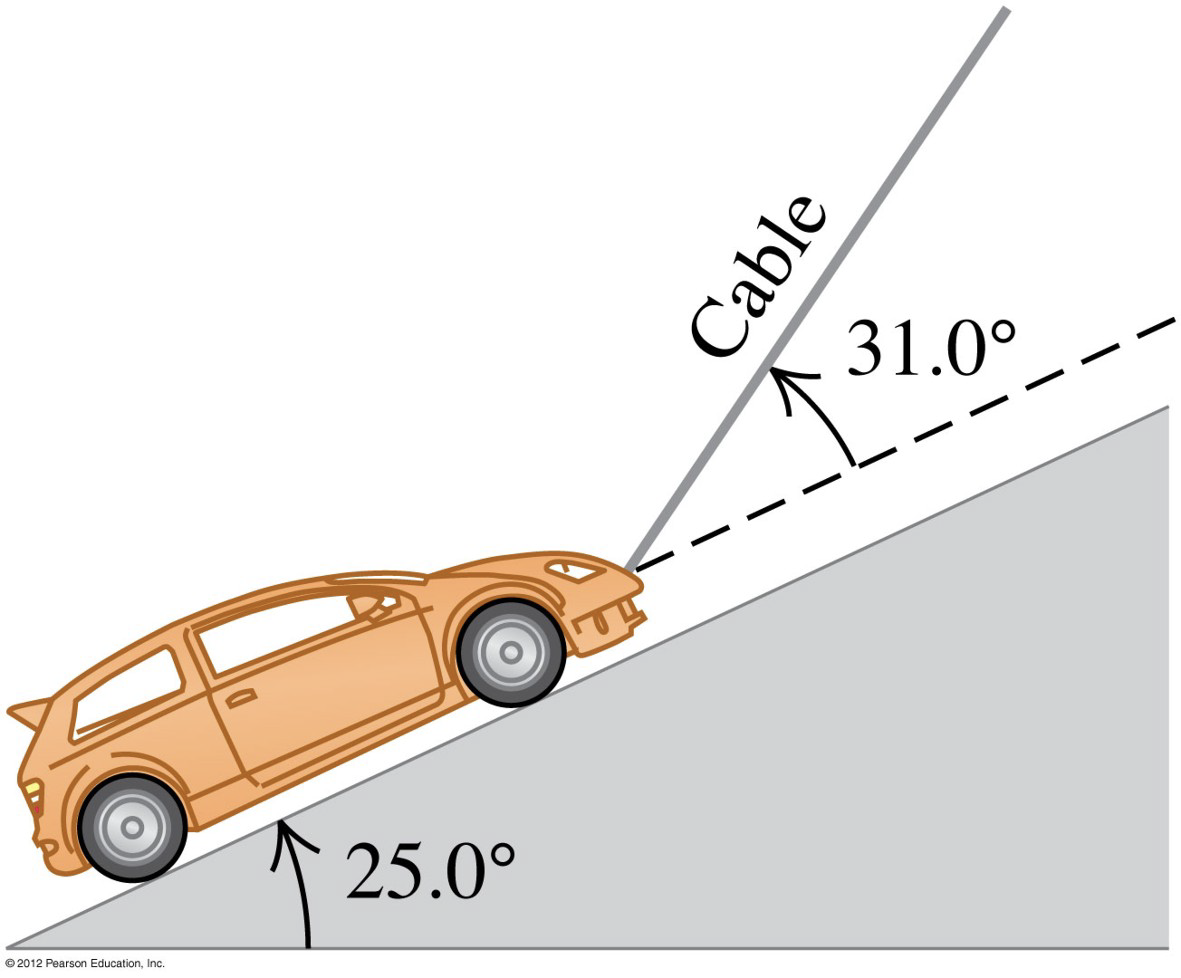
A car with a mass of 1130 kg is held at rest on a frictionless ramp by a cable. The cable is angled 31.0° above the surface of the ramp, and the surface of the ramp is angled 25.0° above the horizontal. Assume all forces act at the center of the car.
- (a) What is the tension in the cable?
- (b) What is the normal force exerted by the surface of the ramp on the car?
Solution:
First, we need to identify all forces and establish a coordinate system:
- Weight (gravity): acting straight down
- Tension (): Acting at 31° above the ramp surface
- Normal force (): Perpendicular to the ramp surface
Let's choose our coordinate system with the x-axis parallel to the ramp (downhill) and the y-axis perpendicular to the ramp.
For equilibrium: and
Step 1: Find the components of gravity. Since the ramp is at 25° above horizontal, the angle between the weight and the negative y-axis is 65°.
Step 2: Write the equilibrium equations. : :
Step 3: Solve for the tension (part a).
Step 4: Solve for the normal force (part b).
Therefore: (a) The tension in the cable is 5460 N. (b) The normal force exerted by the ramp is 7224 N.
Example B — Spaceship Thrust & Coasting (Dynamics)
An kg ship starts from rest in deep space. Engines exert N for 20 s, then shut off. The ship coasts another 12 km at constant speed. How long does the trip take?
Solution:
We can divide this problem into two phases: accelerating (engine on) and coasting (engine off).
Phase 1: Accelerating (engine on)
- Mass: kg
- Thrust force: N
- Initial velocity: m/s
- Time: s
Apply Newton's Second Law to find acceleration:
Final velocity after 20 seconds:
Distance traveled during acceleration:
Phase 2: Coasting (engine off)
- Velocity: v = 300 m/s (constant)
- Remaining distance: 12 km - 3 km = 9 km = 9000 m
Time for coasting phase:
Total trip time:
Example C — Beam with Worker (Rotational Equilibrium)
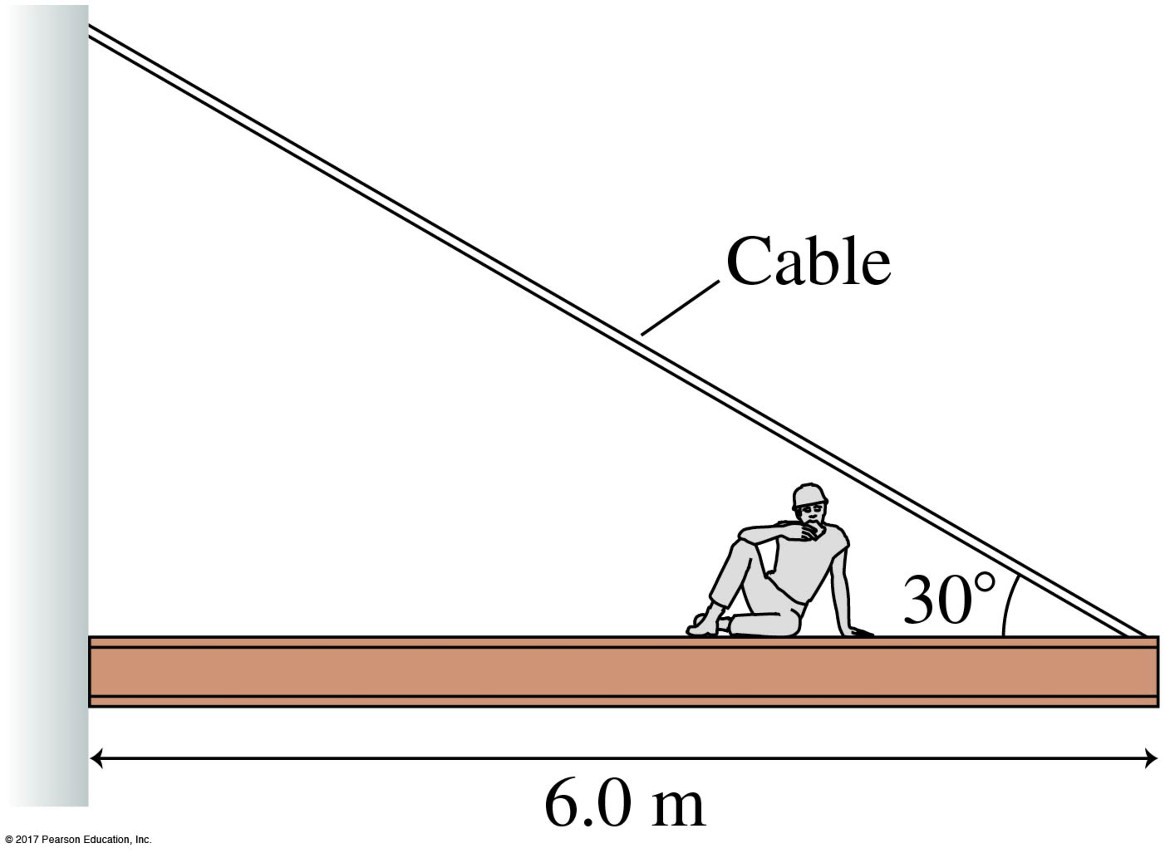
An 80 kg construction worker is 2.0 m from the end of a 6.0 m long steel beam with a mass of 1450 kg. The beam is attached to a wall at one end and held by a cable at the other end. If the beam is in equilibrium, what is the tension in the cable?
Solution:
This is a rotational equilibrium problem. We'll calculate the torques about the wall attachment point (pivot).
Step 1: Identify the forces and their moment arms.
- Beam weight: , acting at the center of the beam (3.0 m from the wall)
- Worker's weight: , acting 4.0 m from the wall
- Cable tension: , acting 6.0 m from the wall at 30° angle
Step 2: Calculate the torques. Taking counterclockwise as positive:
- Beam torque: (CW)
- Worker torque: (CW)
- Cable torque: (CCW)
Step 3: Apply the rotational equilibrium condition.
Step 4: Solve for the tension.
Therefore, the tension in the cable is 15255 N.
Example D — Box on a Truck (Dynamics)
A truck loaded with a heavy box has a total mass of 7500 kg. The truck drives up a slope at a constant speed. Suddenly the box falls out of the back of the truck and the truck begins to accelerate up the slope at . What is the mass of the box? (Friction can be ignored)
Solution:
We can solve this by analyzing the forces before and after the box falls off.
Initial situation (truck with box):
- Total mass: kg
- Moving at constant speed up the slope:
- Slope angle:
For motion at constant speed up the slope, the engine force must exactly balance the component of gravity pulling down the slope.
The weight of the truck and box: acting straight down.
Component of weight parallel to the slope (pulling down):
For constant speed up the slope, the engine force must equal this:
After the box falls off:
- Truck mass: (what we're solving for)
- Box mass:
- Truck acceleration: up the slope
- Engine force remains the same:
Now we apply Newton's Second Law to the truck after the box falls off:
The forces acting parallel to the slope:
- Engine force: (up the slope)
- Component of truck weight: (down the slope)
Rearranging to solve for :
Therefore, the mass of the box is:
6. Key Take‑Aways
- Break every problem into forces, axes, and, when needed, torques.
- Equilibrium set sums to zero; Dynamics set sums to .
- Friction caps at before motion; drops to once sliding starts.
- Gravity acts constantly, but "weight" is what the supporting surface does in response.
0 reads
Last edited